Check the practical details
Dry storage, opening hours and clear access rules often matter more than a long list of advertised amenities.
Route 03 / Support environment
A useful training base supports the hours around the water slot. Look for practical arrangements that let athletes arrive prepared, recover appropriately and return ready to learn.
Start the inspection before the first launch. Where will the group arrive, unload boats, change and warm up? How far are those spaces from the water? What happens in cold weather or heavy rain? These questions expose the everyday friction that a glossy channel photograph cannot show. A venue can have excellent whitewater while still requiring careful planning around access, storage and waiting time.
Map the route between each part of the day. Long transfers, restricted opening hours or a changing room that closes before the final session can undermine an otherwise sensible programme. Ask what is included in the booking and what requires separate access. Do not assume that facilities used by a resident performance squad are available to visiting athletes.
Accessibility should be discussed specifically rather than reduced to a general label. Ask about parking, step-free routes, door widths where relevant, changing arrangements and access to coaching or review spaces. Explain the actual requirements of the people travelling so the operator can respond with useful detail.
A gym is useful only if its equipment, supervision rules and opening times fit the planned work. Ask whether a qualified coach can lead the group, whether athletes need an induction and whether there are restrictions for younger participants. Check capacity: a small room can be adequate for individual work but impractical for an entire squad between water sessions.
Warm-up and movement preparation do not always require a large performance suite. A dry, accessible area with enough room and permission for the intended activity may meet the programme better than a distant gym. The coach should determine exercise selection, loading and progression. This website describes facility questions, not a strength plan or an injury-prevention guarantee.
When comparing services, distinguish access to equipment from access to practitioners. A treatment room does not establish that a physiotherapist is available, and a recovery area does not establish the quality of medical support. Ask about professional qualifications, appointment arrangements, fees and referral procedures. Individual medical decisions belong with appropriately qualified professionals.
Dry storage, opening hours and clear access rules often matter more than a long list of advertised amenities.
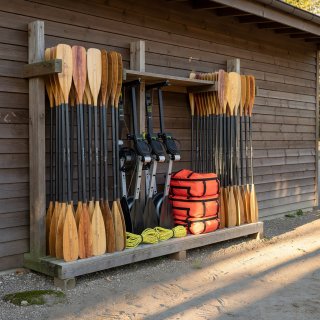
Boat storage needs more than a location on a map. Confirm security arrangements, access hours, rack dimensions and whether equipment can remain overnight. Ask where wet kit can dry and whether repair work is permitted in a designated area. A squad carrying several boats may need a different unloading and storage plan from an individual paddler arriving with one craft.
Discuss cleaning and biosecurity rules before travelling between waterways. The Check Clean Dry campaign is a useful reference for understanding why equipment movement matters. Follow the current procedures required by the destination and the waterways involved. Do not assume a convenient rinse point is equivalent to a complete biosecurity process.
Food, drinking water, shelter and accommodation affect the structure of a training block. Ask whether groups can bring food, use a suitable eating space and refill bottles. Consider journey time to accommodation, not just room price. If the group includes minors, safeguarding, supervision and overnight arrangements need their own explicit plan; a venue booking alone does not resolve them.
A calm review space helps separate reflection from the noise and pressure of the bank. Check seating, power, display connections and whether the room can be booked for your actual session times. The best arrangement may be simple: a protected space where athletes can hear the coach, examine a short video and agree on one point for the next attempt.
For wider reference, INSEP in France and Kisakallio in Finland show how sports environments can bring training and support functions together. They are reference institutions, not a claim that every service is available to every paddler. FINCIS and the World Anti-Doping Agency provide integrity and anti-doping resources that sit outside the ordinary scope of a facility brochure.
Bring these strands into one daily schedule and ask the centre to identify clashes. If the water, gym and review room cannot be used in the necessary order, adapt the plan before arrival. The strongest support environment is not necessarily the most elaborate; it is the one that your group can use consistently, responsibly and without avoidable uncertainty.
Medical, safeguarding and anti-doping questions require the relevant qualified or official source.
Your privacy choices Essential cookies keep this site working. Optional ones help us see what is useful. You can change your choice at any time. More about cookies